
Closing Student Retention Gaps with a Smart Start and Early Momentum
/prod01/dc1-cdn-pxl/media/dallas-college/content-assets/images/about-dallas-college/research-institute/Closing-Student-Retention-Featured.png)
Talon Balcom
Insight Brief - Published December 8, 2025
Introduction
Student retention is a critical challenge for community colleges, where the goal is not only to enroll students but also to guide them successfully to completion or transfer. Early departure can leave students burdened with debt and limited access to labor market opportunities, while the college experiences a loss of enrollment and diminished student outcomes. Predicting which students are most at risk of attrition remains a complex problem. Retention is shaped by a wide mix of academic, environmental, and behavioral factors that interact in ways that are not always obvious. To better understand these dynamics, this study uses student-level data from Dallas College and applies a linear probability model to estimate retention rates based on multiple demographic and academic variables. We examine ten cohorts of nearly 100,000 first-time-in-college students, who initially enrolled at Dallas College between 2014 and 2023, to identify which variables are significantly associated with retention, defined as re-enrollment during fall of the following academic year. Our analysis finds demographic differences, momentum flags, and early course enrollment are key predictors, offering a foundation of insights to inform Dallas College’s Smart Start plan and first-year experience initiatives across colleges nationwide.
Gaps in Retention Rates by Race and Ethnicity
When comparing retention by race and ethnicity, we find significant gaps in retention rates, even while controlling for courseload, program of study, prior achievement, and other demographic variables (Figure 1). Our findings show that international students (+24.3 percentage points) and Asian students (+10.1 percentage points) are significantly more likely to be retained than their White peers. Meanwhile, Hispanic students (-2.4 percentage points), students identifying with multiple races (-5.7 percentage points), and Black students (-6.3 percentage points) all have lower predicted retention rates compared to White students. Results for all other demographic groups are included in the technical notes that accompany this brief.
Figure 1
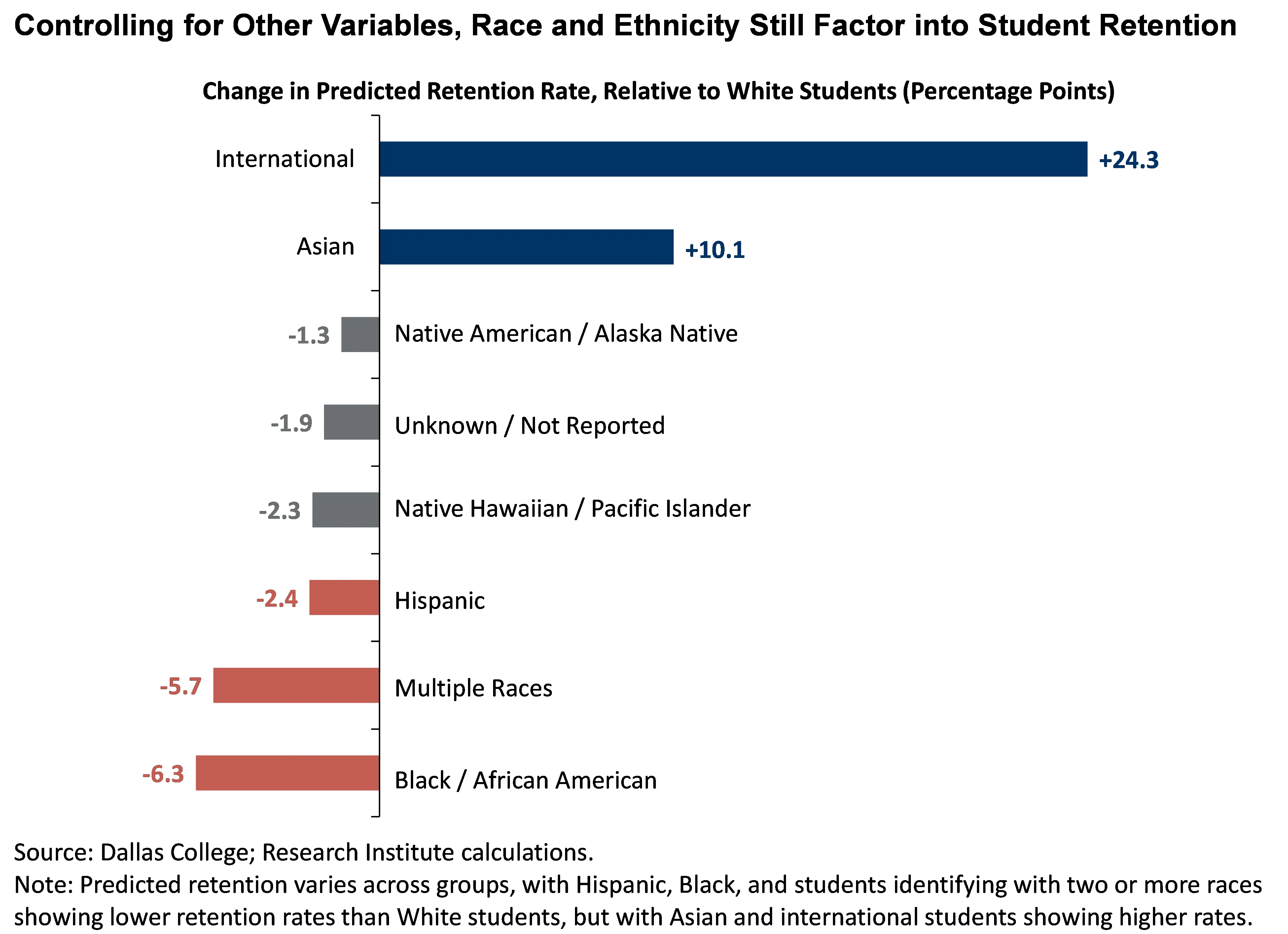
These lower retention rates may stem from systemic barriers such as financial pressures and limited access to academic support. For example, studies on Hispanic students demonstrate that financial pressures, limited institutional support, and systemic inequities contribute to lower persistence and degree attainment rates compared to White peers (Crisp et al., 2015). Research on international student persistence, meanwhile, shows that factors such as GPA, academic integration, and degree plans are strong predictors of retention, while challenges with English remediation or limited social integration can negatively affect persistence (Mamiseishvili, 2012). However, Mamiseishvili (2012) also finds that international students may retain at a higher rate because of their visa requirements and financial commitments, which are strong incentives to complete their degree. While some of the structural reasons for student retention gaps—like visa requirements—are beyond any one college’s control, we also identify several actionable levers to support retention, many of which connect to the idea of sustained college momentum.
College Momentum
Early momentum strategies, such as starting college in the summer or fall after high school, are associated with higher retention rates (Figure 2). Our model shows students who began college in the summer had predicted retention rates of 85.3% compared to 60.1% for those who did not. Similarly, students who began college by the fall after high school had a probability of retention of 65.0% compared to 47.9% for first time in college students who started later. Both results point to the importance of maintaining educational momentum during the critical transition from high school to college.
Figure 2
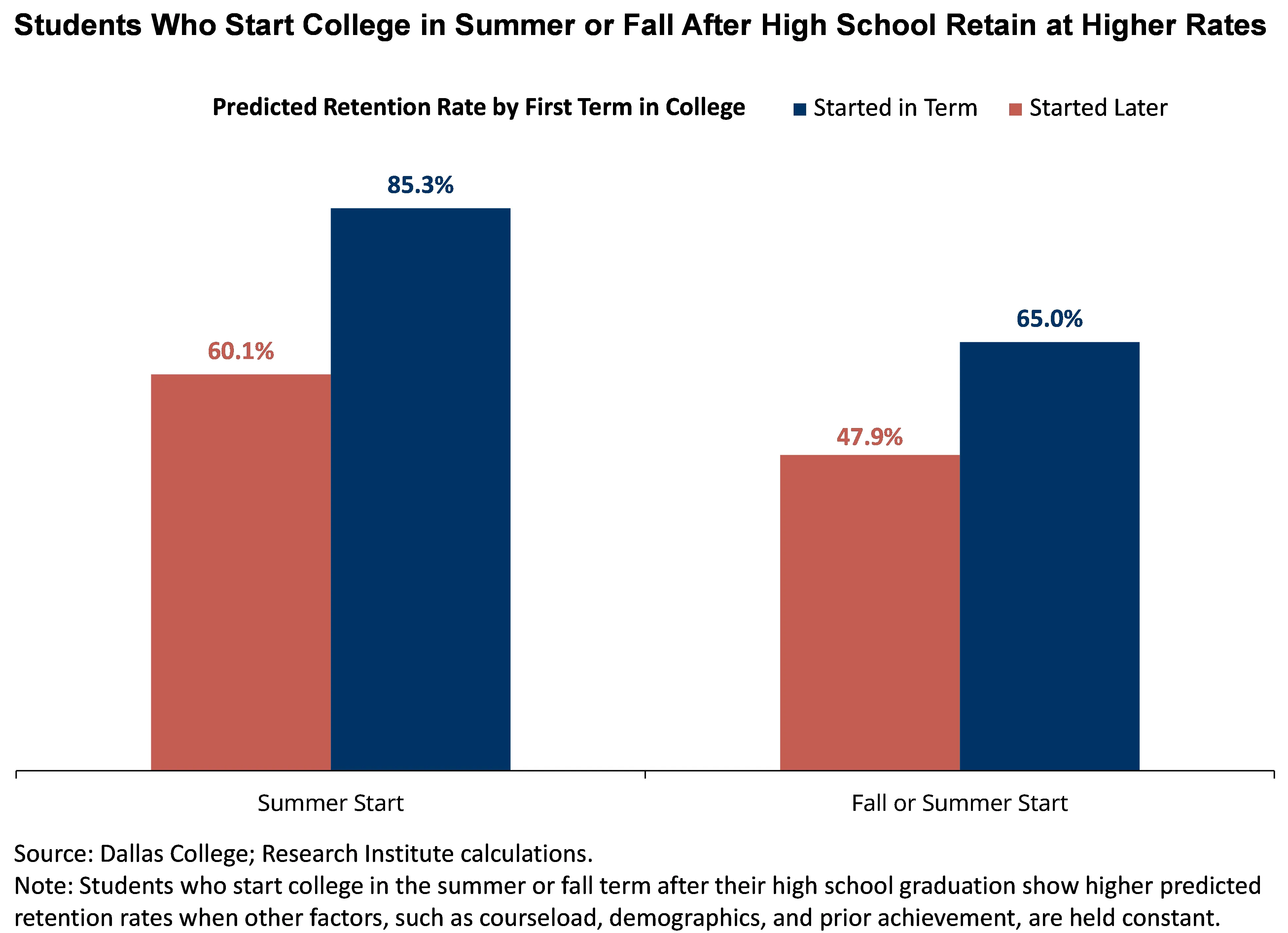
Research on academic momentum highlights that continuous enrollment, particularly through summer terms, is associated with higher retention and degree completion. Liu (2016) found that students who enrolled in summer courses accumulated more credits, returned to college at higher rates the following fall, and completed bachelor’s degrees at greater rates than peers who did not enroll. Students who enroll in summer courses gain a head start by earning credits early, adjusting to the college environment with smaller class sizes, and building familiarity with support services before the busier fall term. Continuous enrollment mitigates the “summer melt” phenomenon, where students who delay entry lose motivation or face life circumstances that pull them away from higher education (Karam et al., 2025).
We also analyze predicted retention rates by credit completion in the student’s first term at Dallas College (Figure 3). Students who complete fewer than 12 credit hours have a predicted retention rate that is 18.3 percentage points lower than students who complete 12 credit hours. There are many factors that may contribute to lower retention among part-time students, including work obligations, financial pressures, and family responsibilities. Predicted retention rises to 76.8% for students completing 13-14 credit hours and approaches 80% for those who complete 15 or more.
Figure 3
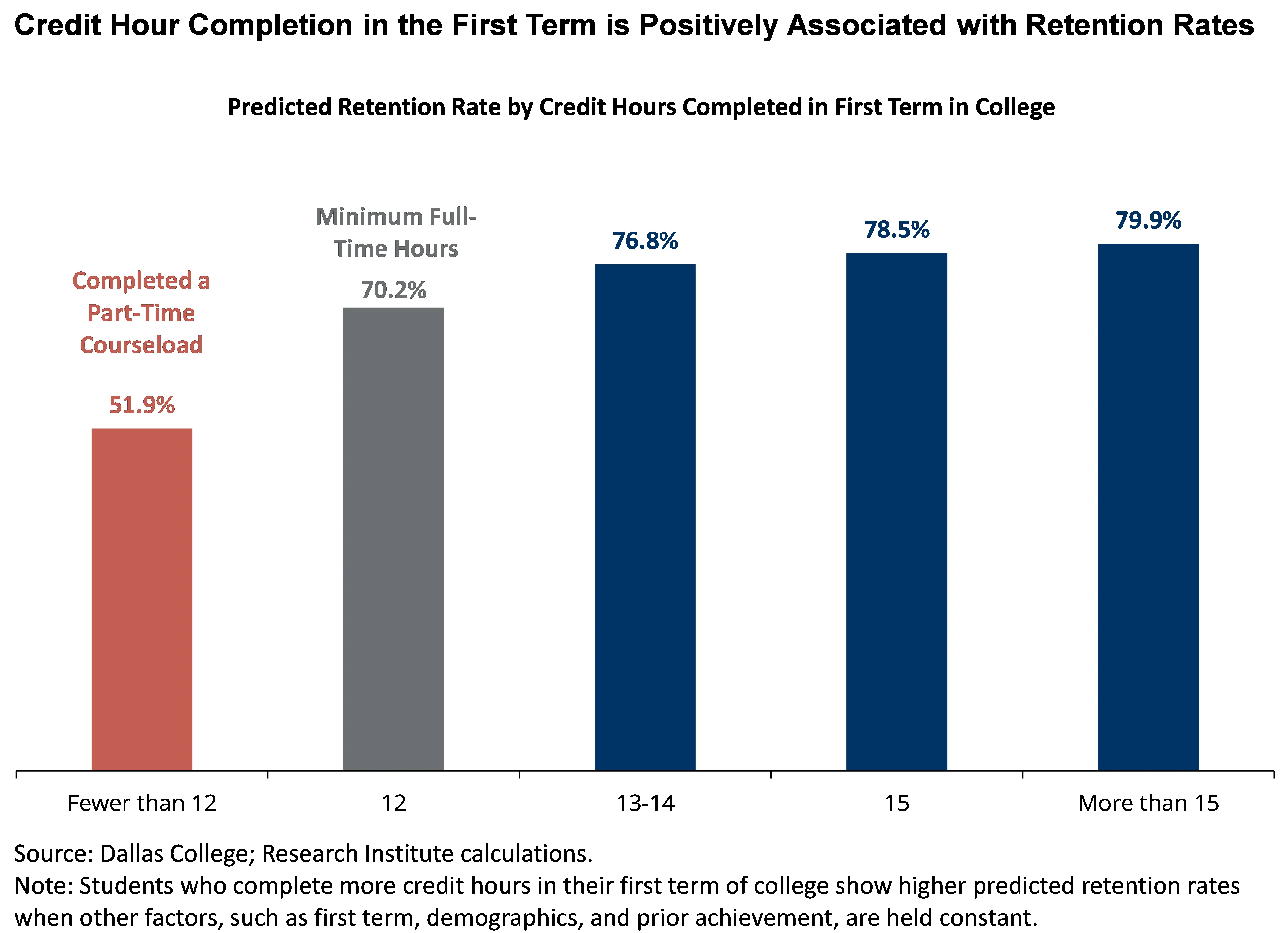
Completing more credits in the first term accelerates progress towards a degree. This early momentum helps students build confidence, stay on track with their program requirements, and maintain the consistency needed for long-term success. While our findings show that probability of retention steadily rises with credit hour completion, similar work by Complete College America recommends a strategy called “15 to finish”, which emphasizes that taking at least 15 credit hours is key for students to not only retain but complete a credential (College Complete America, n.d.).
Early Course Attempts
Another strong predictor of retention is whether students attempt core courses in their first semester (Figure 4). The model shows that taking English and math in the first semester increases the probability of retention by 20.3 percentage points compared to students who took neither course. Early completion of these gateway courses allows students to meet the prerequisites needed for more advanced coursework. Students who delay these courses often face scheduling conflicts or lose momentum, which can lead to a higher likelihood of withdrawal.
Figure 4
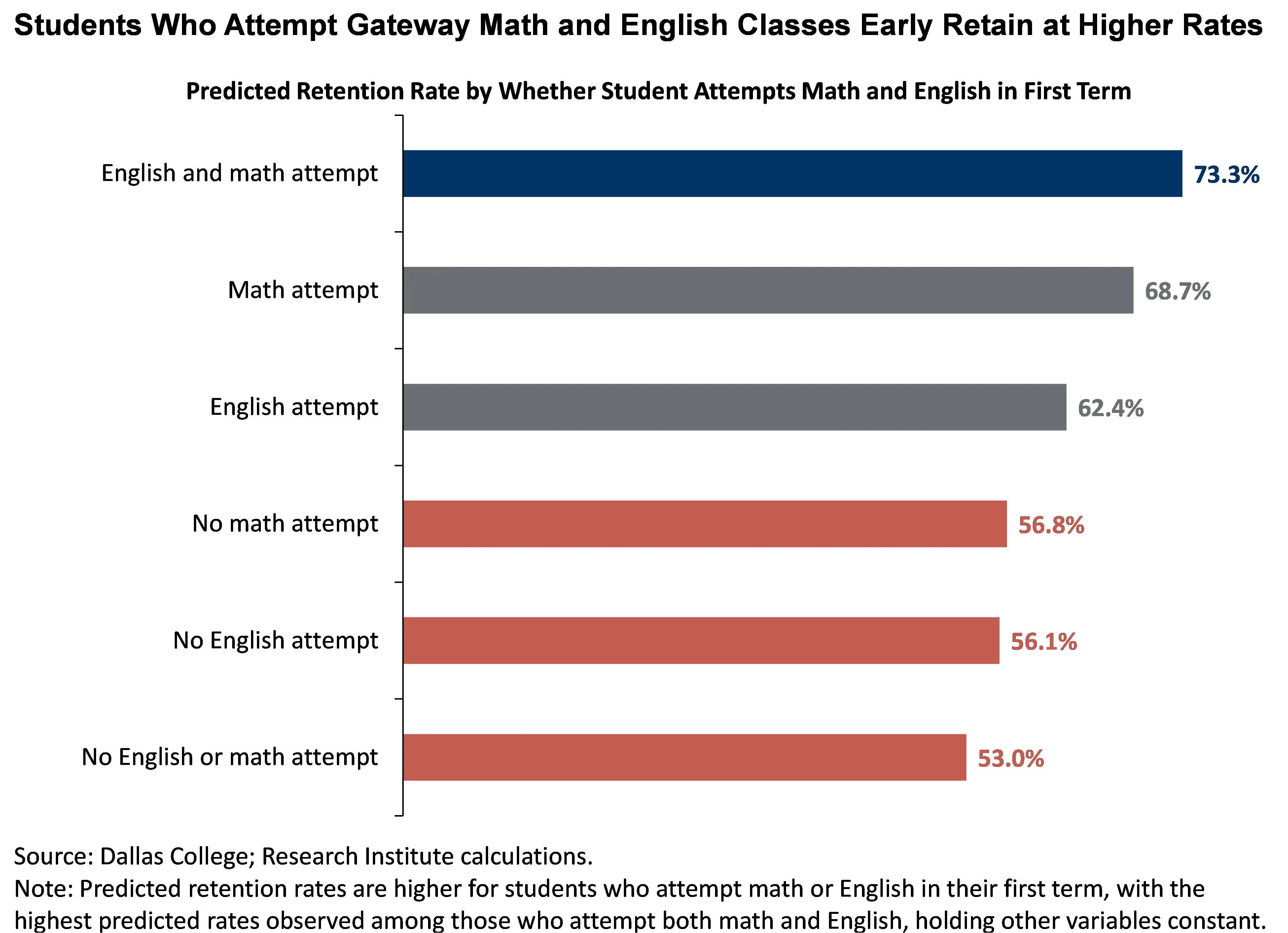
This finding highlights the importance of academic preparedness, structured course planning, proactive advising, and guided pathways that encourage students to take foundational courses during their first term. Strategies such as early alert systems, corequisite support courses, and math and writing tutoring, can help identify and assist students at risk of delaying key courses. Overall, by promoting early progress in core subjects, colleges can help students build stronger academic foundations that lead to higher retention and completion rates.
Conclusion
This analysis demonstrates that student retention is associated with multiple factors, like academic behaviors, demographic characteristics, early momentum, and other variables. We reveal gaps across race and ethnicity that may require targeted support and resources to address, but we also find that momentum variables—like immediate college going, full-time courseloads, and attempting core courses early—can significantly improve a student’s chance of retaining. While we present overall results, our findings are largely consistent across our full ten-year sample period from 2014 to 2023 and remain true when restricting analysis to cohorts after the COVID-19 pandemic and Dallas College’s merger of seven campuses into one college in 2020.
Dallas College’s renewed commitment to enhancing the quality of the first-year experience, exemplified in its Smart Start plan, is well aligned with our results. Smart Start focuses on five major strategies, including a redesigned new student orientation, English and math support, early career exploration and program of study selection, expanded first-year course offerings, and ample opportunities to build quality connections that foster a sense of belonging and community. Dual enrollment, Promise, and summer bridge programs are further examples of a broader push to connect students with Dallas College earlier in their educational journeys, consistent with the idea of building and sustaining momentum in the high school to college transition.
Once students retain, their probability of completing a credential increases significantly. Future research should explore retained students' progress toward completion and identify which variables influence time to graduation most. This will offer Dallas College and other institutions further insights to better support more efficient pathways to credential completion.
College Complete America (n.d.). 15 to Finish/Stay on Track. https://completecollege.org/our-approach/momentum/15-to-finish-stay-on-track/
Crisp, G., Taggart, A., & Nora, A. (2015). Undergraduate Latina/o Students: A Systematic Review of Research Identifying Factors Contributing to Academic Success Outcomes. Review of Educational Research, 85(2), 249–274. http://www.jstor.org/stable/24434257
Karam, R. T., Charles A. Goldman, C. A., Mahan, D., Jamilah, S., & Lu, D. (2025, November 12). Lost but Not Forgotten? Community College Efforts to Reengage Students Lost Before the Census Date. Dallas College. https://www.dallascollege.edu/about/research-institute/student-loss-rand/
Liu, V. Y. T. (2016). Goodbye to summer vacation? The effects of summer enrollment on college and employment outcomes (CAPSEE Working Paper). Center for Analysis of Postsecondary Education and Employment (CAPSEE), Teachers College, Columbia University. https://ccrc.tc.columbia.edu/wp-content/uploads/2016/11/goodbye-to-summer-vacation-the-effects-of-summer-enrollment-on-college-and-employment-outcomes.pdf
Mamiseishvili, K. (2012). International student persistence in U.S. postsecondary institutions. Higher Education, 64(1), 1–17. https://doi.org/10.1007/s10734-011-9477-0
This brief uses a linear probability model trained on student-level administrative data from Dallas College to estimate retention, defined as re-enrollment during fall of the following academic year. The dataset covers 98,802 students from the 2014 to 2023 first-time-in-college cohorts and includes demographic characteristics, cohort indicators, academic achievement, momentum indicators, and credit completion measures. Coefficients and standard errors for each variable included in the model are reported in Table 1, with significance flagged using asterisks. While most results are consistent with prior retention research, we note that, surprisingly, students who had declared a primary program of study had lower retention rates than those who had not, across every Dallas College school of instruction. Because declaring a primary program of study is required for financial aid eligibility, our working hypothesis is that students who declare a primary program of study have greater need and other unobserved characteristics that are correlated with program declaration; thus, the negative coefficients we find may reflect more on the financial need of students than on their positive momentum and intentionality in choosing a program of study. This explanation remains a question for future research.
Table 1
| Variable | Coefficient | Standard Error |
| Race/Ethnicity (Relative to White Students) | ||
| Asian | 0.101*** | 0.01 |
| Black | -0.063*** | 0.01 |
| Hispanic | -0.024*** | 0.00 |
| International | 0.243*** | 0.02 |
| Native Hawaiian/Pacific Islander | -0.023 | 0.05 |
| Native American/Alaska Native | -0.013 | 0.03 |
| Multiple Races | -0.057*** | 0.01 |
| Unknown/Not Reported | -0.019* | 0.01 |
| Other Demographics | ||
| Student Parent | 0.021*** | 0.01 |
| First Generation | -0.001 | 0.00 |
| Veteran | -0.020 | 0.02 |
| Foster | 0.015 | 0.02 |
| Female | 0.055*** | 0.00 |
| Age at Term Start | -0.002*** | 0.00 |
| Momentum Indicators | ||
| Attempted English in First Semester | 0.043*** | 0.00 |
| Attempted Math in First Semester | 0.041*** | 0.00 |
| Fall or Summer Start | 0.091*** | 0.00 |
| Summer Start | 0.099*** | 0.01 |
| Pell Grant Awarded in First Academic Year | 0.069*** | 0.00 |
| Completed FAFSA in First Academic Year | -0.020*** | 0.01 |
| Promise Student | -0.009* | 0.00 |
| Credit Hours Completed in First Term (Relative to 12) | ||
| <12 (Part-Time) | -0.098*** | 0.00 |
| 13-14 | 0.023*** | 0.01 |
| 15 | 0.065*** | 0.01 |
| 15+ | 0.062*** | 0.01 |
| Credit/Dual Credit | ||
| Credit Completion Rate | 0.281*** | 0.01 |
| Dual Credit Student | 0.062*** | 0.00 |
| Completed at Least One Credential as Dual Credit Student | -0.050** | 0.02 |
| Completed at Least 15 Credits as a Dual Credit Student | 0.070*** | 0.01 |
| Placement Level (Compared to Failed) | ||
| ELAR - No Test | 0.031*** | 0.01 |
| ELAR - Passed | 0.027*** | 0.00 |
| Writing - No Test | -0.027*** | 0.01 |
| Writing - Passed | 0.010* | 0.00 |
| Math - No Test | -0.014* | 0.01 |
| Math - Passed | 0.061*** | 0.00 |
| Fall Cohort Variables (Relative to 2014) | ||
| 2015 | 0.037*** | 0.01 |
| 2016 | 0.034*** | 0.01 |
| 2017 | 0.034*** | 0.01 |
| 2018 | 0.018* | 0.01 |
| 2019 | -0.046*** | 0.01 |
| 2020 | -0.028*** | 0.01 |
| 2021 | 0.045*** | 0.01 |
| 2022 | 0.057*** | 0.01 |
| 2023 | 0.004 | 0.01 |
| Primary Program School (Relative to No Program) | ||
| Business, Hospitality, and Global Trade | -0.225*** | 0.01 |
| Creative Arts, Entertainment, and Design | -0.168*** | 0.01 |
| Education | -0.158*** | 0.01 |
| Engineering, Technology, Mathematics, and Sciences | -0.140*** | 0.00 |
| Health Sciences | -0.239*** | 0.01 |
| Law and Public Service | -0.205*** | 0.01 |
| Missing | -0.118*** | 0.01 |
| Manufacturing and Industrial Technology | -0.143*** | 0.01 |
| Degree Seeking Type (Relative to Associate) | ||
| Baccalaureate | 0.083* | 0.04 |
| Certificate | -0.060*** | 0.01 |
| No Primary Program of Study | -0.003 | 0.02 |
| Non-Degree Seeking | 0.024* | 0.01 |
| Skills Award | -0.148** | 0.05 |
| Constant | 0.364*** | 0.01 |
Sources: Dallas College; Research Institute calculations.
Notes: Retention is defined as whether a student remains on a successful academic path from one year to the next. A student is considered retained if, by the following academic year, they remained enrolled at Dallas College, graduated from Dallas College, or transferred to another college. Coefficients represent the estimated change in retention probability associated with a one unit change in each variable in a linear probability model. Standard errors are reported alongside each estimate. Asterisks indicate statistical significance: * p < .05, ** p < .01, *** p < .001.