
Generational Gains: How Dallas College Students Advance Family Earnings through Education
/prod01/dc1-cdn-pxl/media/dallas-college/content-assets/images/about-dallas-college/research-institute/how-dc-shapes-family-earnings.png)
Navi Dhaliwal
Insight Brief - Published October 29, 2025
Introduction
Dallas College, like other community colleges, aspires to be a place where all people, no matter their age, income, or background, have an equal opportunity to learn and advance their lives. With this open access mission, the College serves students who range from dual-enrolled high schoolers to working adults with children of their own. Yet while community colleges have been successful in expanding educational access, their ability to catapult students from the lowest to highest income quintiles has been modest (Chetty et al., 2017a). Although community college students do not realize drastic wage growth, this does not mean that they do not find value in their educational experience, even if their economic progress is incremental (Dhaliwal, 2025).
In a series of interviews, the Research Institute recently asked Dallas College students to share their stories of socioeconomic mobility across generations. In their own words, students voiced how personal resilience, family support, and institutional resources were key factors in their educational and economic advancement (Jamilah, 2025). In this accompanying brief, we explore how the numbers align with student narratives. Drawing on data from the Texas Education Research Center, we find that many Dallas College students experience rapid upward mobility—often out-earning their parents within just a few years after college. Not every student leaps to the top in a single vault, but many climb steadily upward, building genuine economic momentum.
How We Measured Mobility
To study whether Dallas College students realize intergenerational mobility, we gathered data from the Texas Education Research Center, a state longitudinal data warehouse that contains linked records from the Texas Education Agency (PK-12), Texas Higher Education Coordinating Board (postsecondary), and Texas Workforce Commission (employment and earnings). Using this source, we constructed a dataset of 476,848 students who first enrolled at Dallas College between 2008 and 2017, were first-time-in-college (FTIC), traditional-age (under 25), dependent, and applied for financial aid during their first year of enrollment. For this subset of students, we then compared parental adjusted gross income (AGI) from their earliest FAFSA (Free Application for Federal Student Aid) to students’ post-college earnings, captured in Texas Workforce Commission records. To ensure that they were comparable, we adjusted all values for inflation to 2024 dollars.
Sidebox 1: FAFSA Adjusted Gross Income vs. Texas Workforce Commission Wages
Parental income is drawn from FAFSA-reported adjusted gross income (AGI), which reflects the family’s total taxable income at the time of college entry, potentially including one or both parents’ earnings. This measure captures household financial capacity but represents a single point in time and excludes untaxed income, assets, and non-filers who did not complete the FAFSA. In contrast, student earnings come from Texas Workforce Commission (TWC) wage records, which cover formal employment in Texas on a quarterly basis. Unlike AGI, TWC data reflect individual—not household—earnings and exclude self-employment, informal employment, and federal, military, and out-of-state jobs. Because AGI and UI wages differ in scope, timing, and unit of analysis, comparisons between the two should be interpreted as relative indicators of economic mobility, not direct dollar-for-dollar measures of family versus student income. In addition, we restrict our analysis to students who work at least three out of four quarters per year in TWC data, linearly interpolating up to one missing quarter of earnings data. We do not impute zeroes when more than one quarter of wages are missing for a year; this means that our comparisons between parent and child condition on the child already being employed for most of the year.
Since we are not able to observe parent age on the FAFSA, we cannot directly compare parent earnings at a certain age to child earnings at that same age. Instead, we compare after-college earnings of children to AGI per parent at the time that the child first enrolled in college. FAFSA-reported AGI may reflect the income of one or two parents, but we do not observe how many parents contribute to AGI in our dataset—only total AGI. For dependent students with separated or divorced parents, the FAFSA includes only the income of one parent providing the greater share of financial support. And even when parents are not separated or divorced, not all households have two parents earning income. To adjust for this, we assume for our baseline case that 1.5 earners contribute to parental AGI. Thus, we calculated AGI per parent as AGI divided by 1.5—meaning students must earn more than this amount to have surpassed one parent. In our results, we include a range of estimates from a relaxed (AGI divided by 2) to a conservative (total AGI) case but focus our discussion on the baseline scenario.
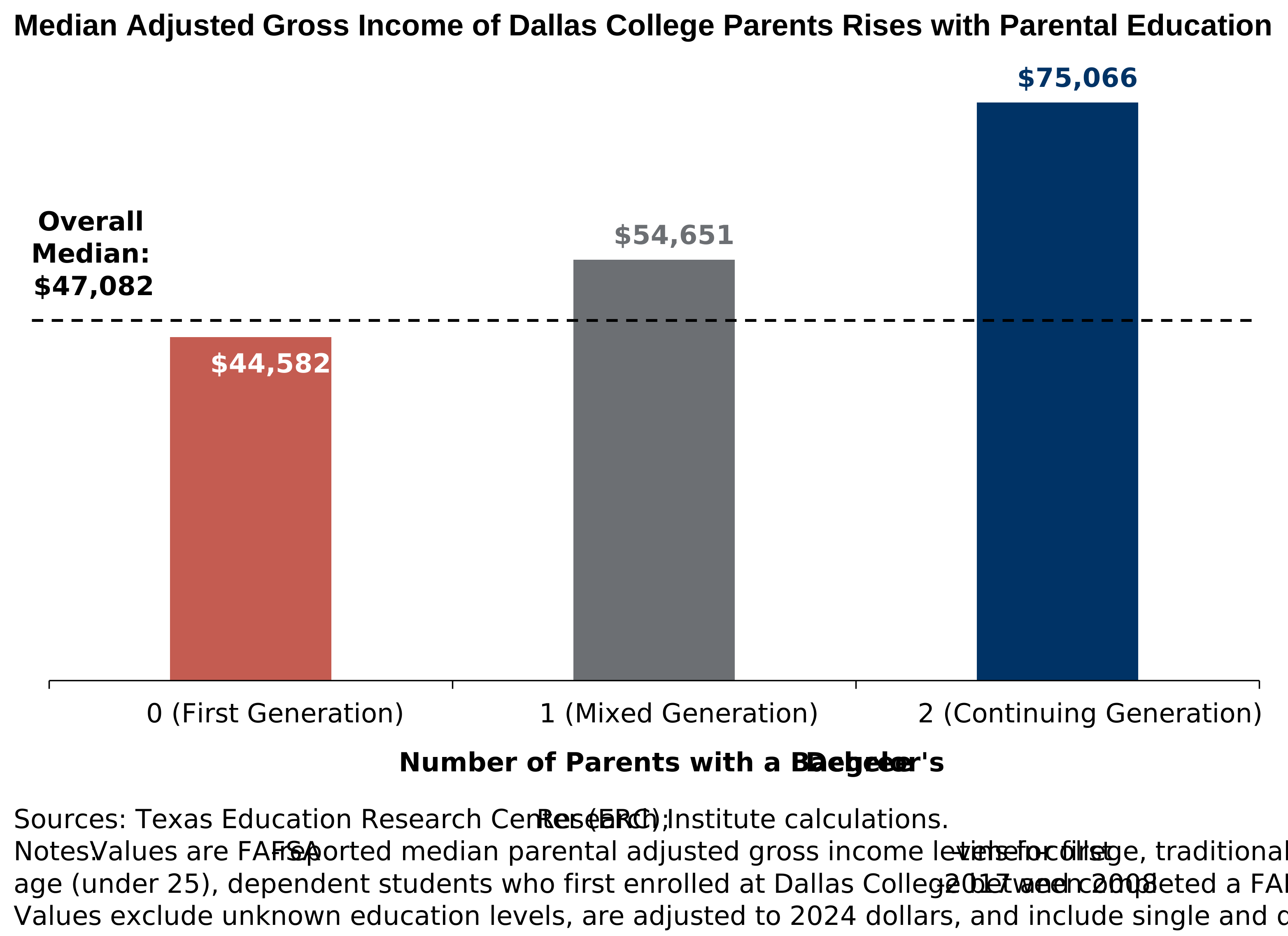
We also used FAFSA data to capture the education levels of students’ parents. Throughout all ten cohorts we analyzed (2008-2017), we consistently found that a large proportion of our sample were first generation college students. Across our full sample, 55% of students had two parents with no more than a high school diploma, 26% had one parent with a bachelor’s degree or beyond, and 19% had two parents with a bachelor’s degree or beyond. We found that median parental AGI scaled with the educational attainment of the parents, ranging from $44,582 for first generation students to $75,066 when both parents had bachelor’s or higher degrees (Figure 1). Overall median parental AGI, across all parental education levels, was $47,082 per year.
Figure 1
Mobility Rates at Dallas College
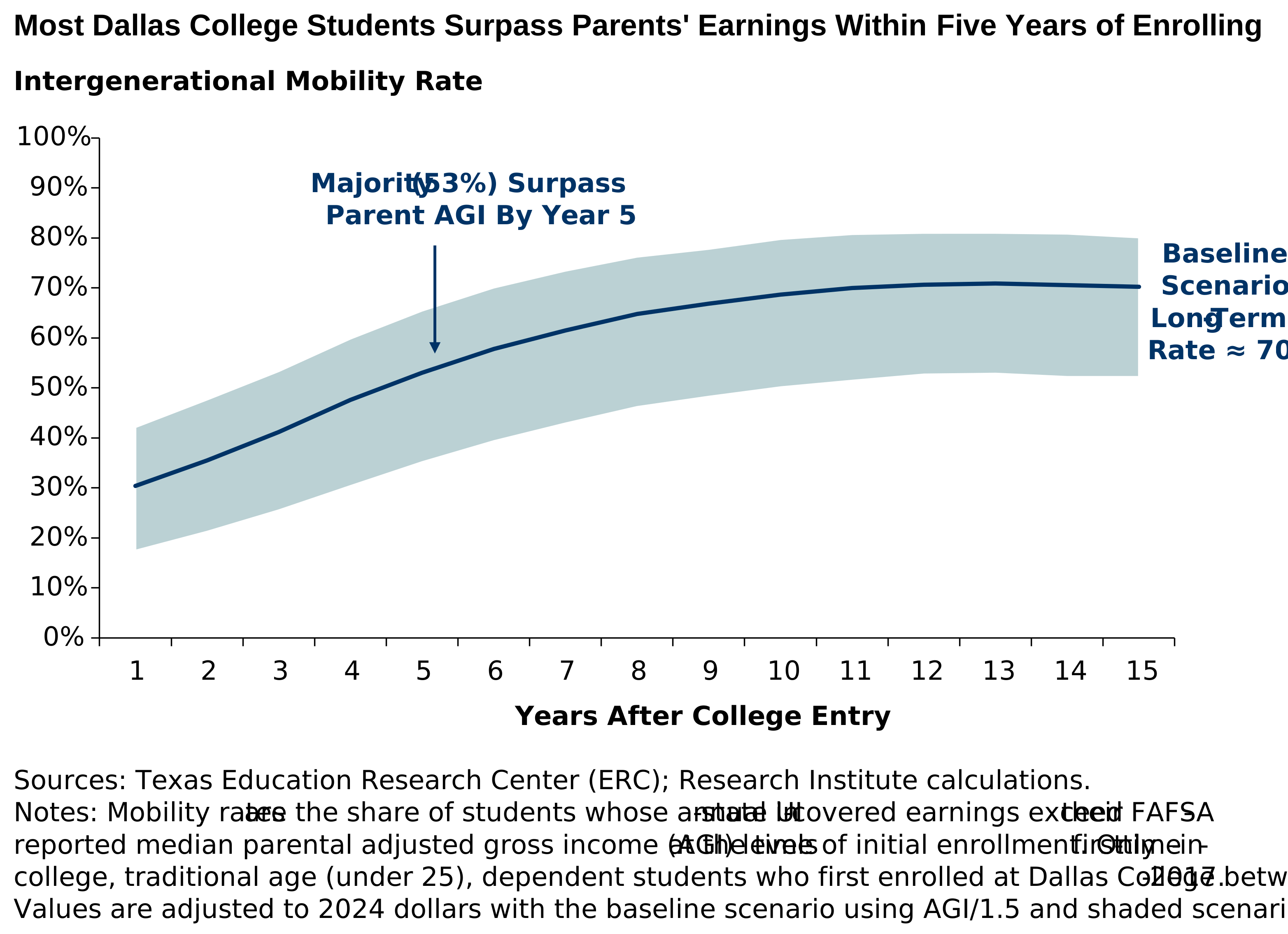
Pooling together all cohorts in our sample, we find that 53% of students, across all levels of attainment (some college with no credential, skills award, certificate, associate degree, etc.), realize intergenerational mobility within five years of enrolling at Dallas College, relative to what their parents were earning when the student first enrolled (Figure 2). Shaded areas of the figure show how this rate varies by scenario, from our most relaxed (surpassing the income of one parent) to our most conservative (surpassing the combined income of both parents). The mobility rate increases over time. By ten years after enrolling at Dallas College, 69% of students experience upward mobility relative to their parents. In our baseline scenario, after adjusting for inflation, students earn around $2,000 more than each parent in year five after college and go on to earn around $16,000 more by year ten, amounting to a more than 50% increase over per-parent AGI.
Figure 2
Perhaps unsurprisingly, we also find that parental education level and student college completion both factor into upward mobility rates. Five years after enrolling at Dallas College, baseline mobility rates are 61% for first generation students, 48% when one parent had a bachelor’s or advanced degree, and 37% when both parents did. This is driven by the lower parental AGI of first generation students, though they post similar fifth year wages to continuing generation students. The findings for college completion are more nuanced. In terms of outearning their parents, it takes until year eight after college entry for mobility rates of students with a credential to outpace those with some college alone. This result underscores the competing pressures that can make college completion challenging for many community colleges students; while students may enter college intending to complete, exiting before completion can lead to an immediate extra income source for a student’s household, oftentimes making them the highest earner in their family.
Cohort Comparisons Show Progress
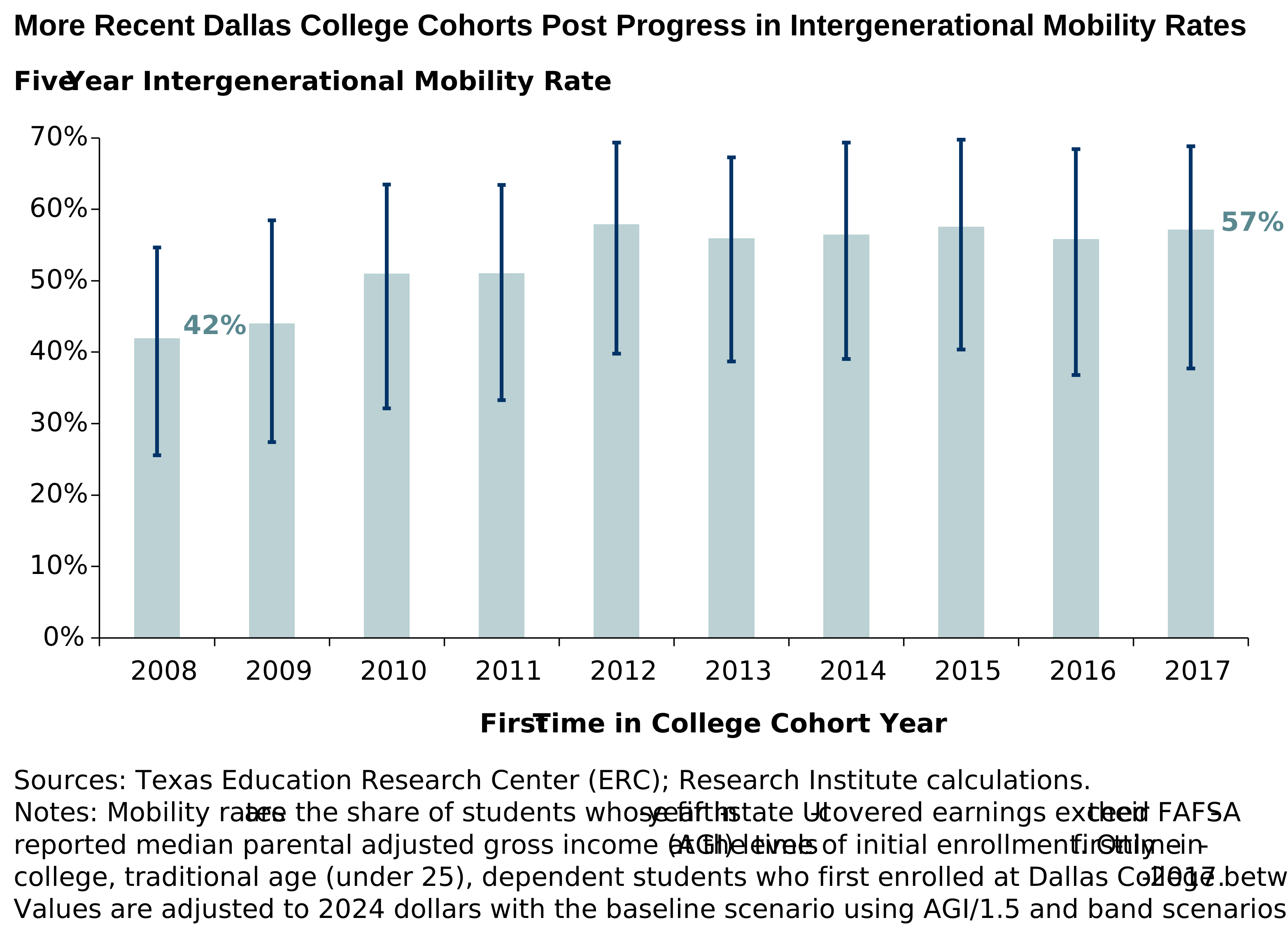
We also disaggregate by cohort to see whether and how rates of intergenerational mobility have changed over time for Dallas College students. Nationwide, rates of intergenerational mobility have historically declined over the decades, from near 90% for children born in 1940 to 50% for children born in the early to mid-1980s (Chetty et al., 2017b). In our sample, however, we see five-year upward mobility rates steadily rise from the 2008 cohort to the 2017 cohort. While just 42% of students in the 2008 cohort realized economic mobility in our baseline case, 57% did for the 2017 cohort (Figure 3). This trend is driven both by gradual growth in student earnings from cohort to cohort and a large decline in parental AGI. For the 2008 cohort, median AGI per parent was $37,661 in our baseline scenario, compared to fifth-year median student earnings of $36,748; by the 2017 cohort, these values were $30,554 and $40,607, respectively. In other words, students from the 2017 cohort were not only earning about $4,000 more in real terms than those from the 2008 cohort in their fifth year after college, but they also came from families where each parent earned about $7,000 less at the time that they started college.
Figure 3
Conclusion
Overall, there have been clear gains in what Dallas College students go on to earn after college. But the population that Dallas College serves also exhibits greater financial need in more recent years than in years past, with students coming from families with fewer resources on average. Students often earn more when they leave Dallas College than what their parents made when they entered. But when median parental AGI for Dallas College students is $47,082 per year, even surpassing this amount is no guarantee of a living, thriving wage. Under these conditions, many students must balance employment with education or face the difficult choice of leaving college to earn additional income for their parents and families. As our interviews with students surfaced, a Dallas college education can have powerful, transformational effects on the lived experiences of our students. But the road to get there requires fierce individual determination, strong interpersonal support systems, and barrier-busting institutional aid and resources.
Going forward, Dallas College should continue to invest in basic needs assistance, wraparound services, and other offerings that help students continue their education uninterrupted. In the course of this research, we found that Dallas College completers had parents with a median AGI around $10,000 more than non-completers. This modest level of financial security can make the difference in whether students ultimately complete. When they do, they quickly become the breadwinners of their households – not just for a few years, but for the long term. Not every community college journey is a tale of rags to riches. But Dallas College students are making meaningful progress—advancing themselves and their families one generation at a time.
Chetty, R., Friedman, J. N., Saez, E., Turner, N., & Yagan, D. (2017a). Mobility report cards: The role of colleges in intergenerational mobility (No. w23618). National Bureau of Economic Research (NBER). https://www.nber.org/system/files/working_papers/w23618/w23618.pdf
Chetty, R., Grusky, D., Hell, M., Hendren, N., Manduca, R., & Narang, J. (2017b). The fading American dream: Trends in absolute income mobility since 1940. Science, 356(6336), 398–406. https://www.science.org/doi/10.1126/science.aal4617
Jamilah, S. (2025). Agents of Socioeconomic Mobility: How Dallas College Students Reshape Family Trajectories. Research Institute at Dallas College. https://www.dallascollege.edu/about/research-institute/igm1-oct-2025/
Dhaliwal, N. (2025). Finding Their Next: Career and Transfer Outcomes. Research Institute at Dallas College. https://www.dallascollege.edu/about/research-institute/career-and-transfer-outcomes-2025/