During Disability Awareness Month, a Look at How Far We’ve Come
Oct. 1, 2025
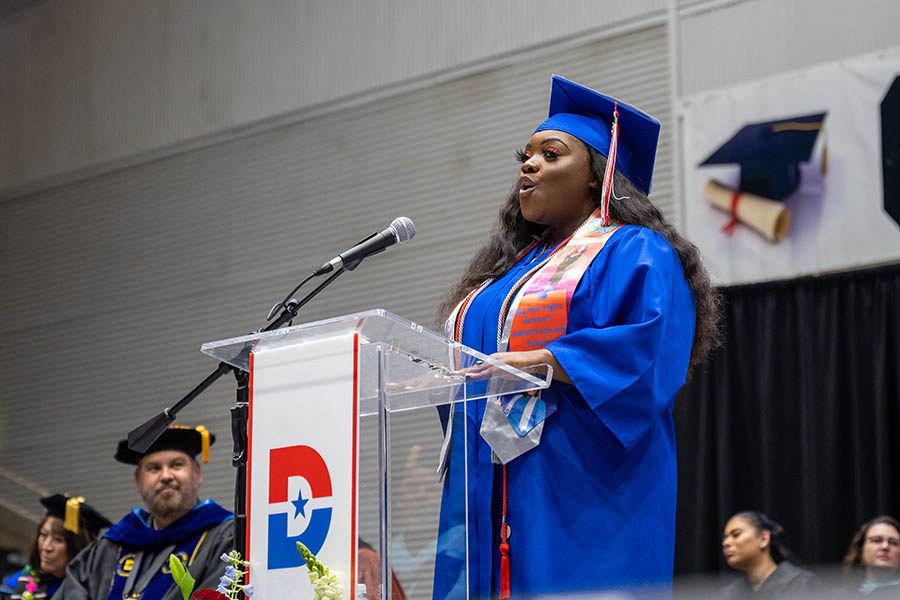
When Ariana Dewberry spoke at Dallas College Graduation last Spring, she talked about how Dallas College Accessibility Services supported her as she re-entered college after suddenly losing her eyesight.
“My journey at Dallas College has been full of advocating, receiving accommodations and adapting to be the best version of myself,” she said. “I haven’t allowed my eyesight to determine my future, and you shouldn't allow any limitation to deter you from being the person you desire to be.”
If you missed her inspiring speech, you will have a chance to hear her on Oct. 15, 12:30-2 p.m. Her online presentation, “White Cane Awareness: Navigating Vision Loss With Independence and Confidence,” is part of a speaker series and campus-based Resource Fairs happening during the month of October in celebration of Disability Awareness Month.
It’s estimated that one quarter of the adult population of the United States has some sort of disability, according to the Centers for Disease Control and Prevention. In honor of Disability Awareness Month, and in celebration of the 35th anniversary of the passage of the Americans with Disabilities Act, we are looking into Accessibility Services at Dallas College with Dean of Accessibility Services Beverly Neu Menassa.
ADA is the civil rights law that prohibits discrimination against individuals with disabilities in public life, including jobs, schools, transportation and many public and private places. The purpose of the law is to make sure that people with disabilities have the same rights and opportunities as everyone else.
 Dean Neu Menassa, what does ADA mean to you?
I think it is one of the most significant pieces of civil rights law in the United States. Having a law that protects the rights of individuals with disabilities is extremely important. It provides a foundation for how colleges and universities ensure that there's equal access for educational programming and programs of study.
You’ve been working in this field for 25 years. How has the education system when it comes to equity for the disabled community?
When I graduated college in 1990, the same year the law was passed, I had a learning disability, but there was no help. I found coping strategies to be successful, but I think about all the people who didn't have support.
Now, accessibility is in our communities; it’s in our society. This generation of students understands their rights, and they are vocal. We no longer hide our disabilities — we’re more visible in the community and in higher ed.
Like all students, some students with disabilities may feel isolated at college. However, case managers encourage students to get involved, and many of our students with disabilities join programs, clubs or organizations through Student Life and Engagement and Support Programs. They are welcomed and supported.
Twenty-five years ago, faculty sometimes complained about making accommodations for students. Now, they come to me asking what else they can do to help students succeed.
What is the best way to be an ally to someone who may have a disability?
Accessibility is the responsibility of everyone at Dallas College. If you see an automatic door or elevator not functioning, report it. If there’s an event that’s being held in a place not accessible to people with limited mobility, bring it to someone’s attention. If you see someone struggling, ask if you can help.
But the biggest thing you can do is to grow your understanding about the disabled community. Throughout the month of October, Accessibility Services is hosting events, activities and learning opportunities designed to increase awareness, spark dialogue and promote accessibility across our campuses.
We encourage you to take part in these events — not just to show support, but to become an advocate for people with disabilities within and beyond our college community.
By learning about disabilities and disability services you may someday advocate for your workplaces to hire employees who are disabled. The average unemployment rate for people with disabilities is often double that of the full labor force.
What role does Accessibility Services play in ensuring student success?
Accessibility Services partners with students with disabilities to identify, reduce or eliminate educational barriers. Our purpose is to provide reasonable and appropriate accommodations for qualified students with disabilities, assist students in developing self-advocacy skills, educate the campus community about disability-related issues and ensure compliance with ADA laws.
But Dallas College Accessibility Services goes beyond just providing accommodations for our students, we remove barriers. Case managers meet with students as many times as a student wants during each semester. They check that students are using their accommodations effectively, making good academic progress in their classes and refer them to help for other life stressors that may prevent their success.
As a result, students receiving accommodations from Dallas College Accessibility Services had a 76% course completion rate in Spring 2025, and a persistence rate of 84% from Fall 2024 to Spring 2025.
Visit the Accessibility Services website for campus locations, more information or to schedule an appointment. You may contact Accessibility Services by phone (972-669-6400) or email (DSSO@DallasCollege.edu).
- Campus News
- Resources