
Military and Veteran Students at Dallas College
/prod01/dc1-cdn-pxl/media/dallas-college/content-assets/images/about-dallas-college/research-institute/veteran-brief-(2).png)
The Research Institute, Labor Market Intelligence Center, and Strategic Research and Analytics
Insight Brief - Published May 25, 2026
Introduction
Veterans remain a significant demographic in the United States, even as their share of the population continues to change over time. Recent estimates from the U.S. Census Bureau’s American Community Survey (ACS) indicate that there are approximately 16.2 million veterans nationwide, which is roughly 6% of the adult population. Texas consistently has the largest veteran population of any state with a current population of about 1.5 million veterans, which also comprises approximately 6% of the adult population in the state. At the regional level, the Dallas-Fort Worth-Arlington metropolitan area is home to an estimated 330,000 veterans, which is approximately 5.4% of its population and also one of the largest veteran concentrations in the country. More specifically, around 81,000 veterans reside in Dallas County, representing about 4% of the adult population in the county (U.S. Census Bureau, 2024). There are substantial opportunities to enroll or re-enroll veterans into postsecondary education within Dallas County, especially through the support of federal and state benefits such as the Post-9/11 GI Bill and the Hazlewood Act, which can significantly reduce or eliminate tuition costs (Dallas County, n.d.; Texas Veterans Commission, 2026a). Also, Dallas College, among other local two- and four-year institutions, offers a range of veteran services, including academic advising, credit for military training, and career support (Dallas College, 2026b). However, veterans transitioning into civilian life and higher education often experience a lack of clear direction and accessible information, which creates challenges in navigating benefits, enrollment processes, and academic pathways. These obstacles highlight the need for a clearer understanding of the educational and labor market characteristics of veteran students in the region.
This brief analyzes the landscape of veteran students in the Dallas-Fort Worth region. It examines where veterans live, how their educational outcomes differ across counties, and highlights enrollment patterns, program preferences, and key industries where veterans are employed. The brief also focuses on the veteran population at Dallas College with insights on academic pathways and challenges that affect student success based on qualitative research findings. The brief concludes with a roadmap of opportunities, including financial supports and strategies to improve veteran recruitment, re-enrollment, and completion outcomes.
Veterans in DFW
Where do they live?
ACS data identify the five DFW counties with the largest veteran populations as Tarrant, Dallas, Denton, Collin, and Parker (Table 1). In contrast, nearby counties including Ellis, Johnson, Hunt, Kaufman, Rockwall, Hood, and Wise each have veteran populations of 10,000 or fewer. Within Dallas County, analysis by the Labor Market Intelligence Center (LMIC) shows that from 2018-19 through 2024-25, the top ten zip codes where Dallas College veterans resided were largely underserved communities. These areas are concentrated in southern and eastern Dallas, as well as in Garland, Mesquite, DeSoto, and Cedar Hill. Over this period, veterans were most concentrated in DeSoto (zip code 75115) and Cedar Hill (zip code 75104) (Dallas College, 2026a).
Table 1. Veteran Representation Across DFW Counties, 2020-2024
|
County Name |
Total Population |
Total Veterans |
Veteran Share of Population (%) |
|
Dallas |
1,960,984 |
81,776 |
4.17% |
|
Tarrant |
1,614,226 |
99,576 |
6.17% |
|
Denton |
750,181 |
43,911 |
5.85% |
|
Collin |
875,017 |
42,042 |
4.80% |
|
Parker |
124,156 |
12,251 |
9.87% |
Source: American Community Survey (ACS) 2024 5-Year Data.
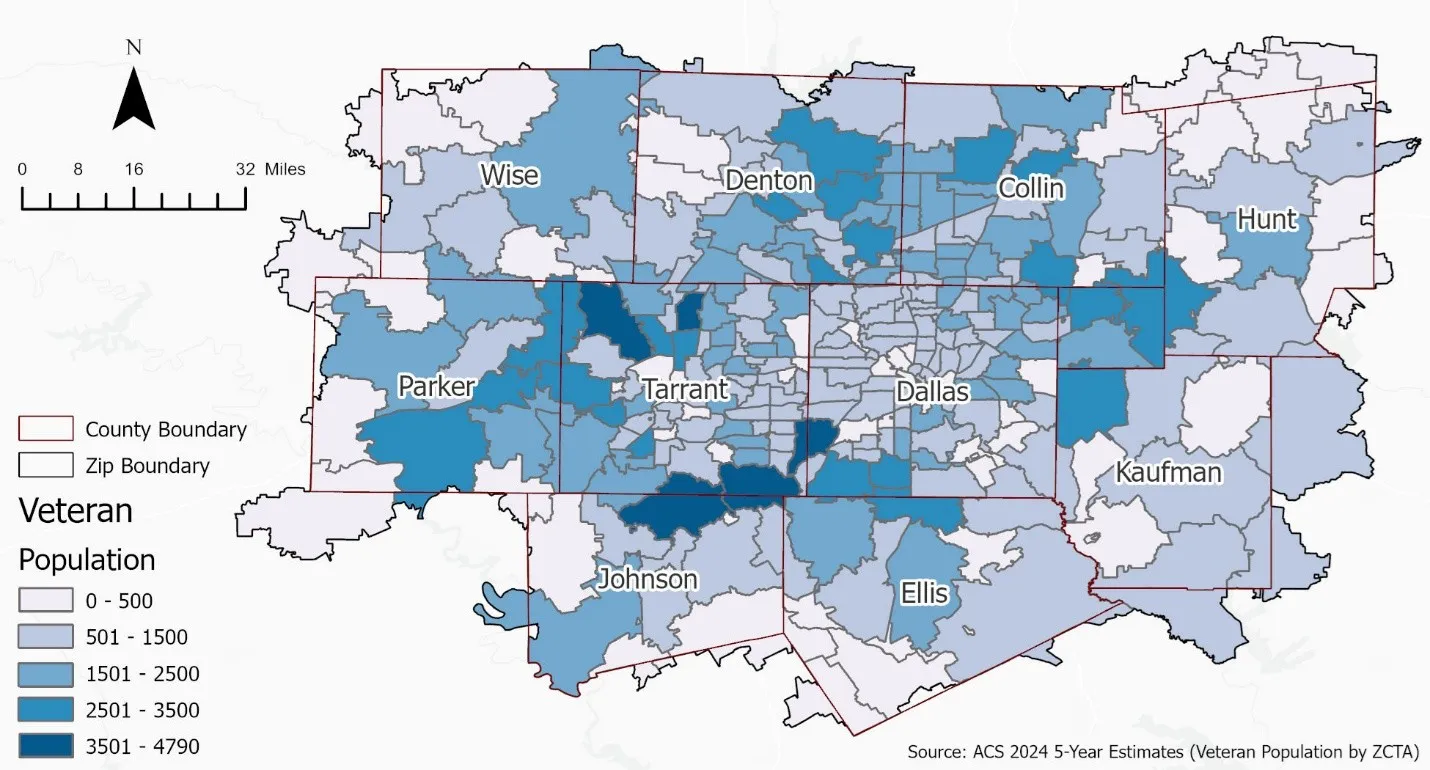
A choropleth map of veteran populations across the DFW metroplex at the census tract level shows that veterans are spread throughout the region, but they tend to cluster more heavily in suburban areas instead of the urban cores of Dallas and Fort Worth (Figure 1). Some of the highest concentrations are in northwest and southern Tarrant County, southern Dallas County, and parts of Denton and Collin Counties. The areas surrounding Fort Worth have the strongest concentration of veterans, which reflects their proximity to the Naval Air Station Joint Reserve Base (NAS JRB). The concentration of veterans in southern Dallas and Tarrant counties implies that a noteworthy proportion of the veteran population resides in lower-income, underserved areas. Fast-growing counties like Denton and Collin have several concentrated pockets of veterans, which may indicate that they are choosing to settle in newer residential developments. However, a different pattern occurs in the west where population clusters in Parker County suggest a preference among some veterans for more rural communities.
Figure 1. Veteran Population Density in the DFW Region
Source: American Community Survey (ACS) 2024 5-Year Data.
What is their general educational attainment?
Educational attainment among veterans differs across the five DFW counties with the largest veteran populations (Table 2). ACS data show that veterans in Collin and Denton counties hold the highest levels of education. Nearly half of veterans in Collin County (48.71%) hold a bachelor’s degree or higher, followed by veterans in Denton County (45.12%). In comparison, Dallas County has the lowest share of veterans with a bachelor’s degree or higher (33.90%) and the highest proportions of veterans with only a high school diploma (23.06%) or less than a high school education (5.32%). Tarrant and Parker counties fall in the middle, although Parker stands out with a relatively high share of veterans with only a high school education (22.81%). Across all counties, a significant proportion of veterans attain some college or an associate degree, particularly in Tarrant (39.11%) and Dallas (37.72%).
Table 2. Veteran Educational Attainment by County, 2020-2024
|
County Name |
Total Veterans |
Bachelor’s or Higher (%) |
Associate or Some College (%) |
High School Graduate |
Less than High School |
|
Dallas |
81,776 |
33.90% |
37.72% |
23.06% |
5.32% |
|
Tarrant |
99,576 |
37.18% |
39.11% |
20.00% |
3.71% |
|
Denton |
43,911 |
45.12% |
36.91% |
15.07% |
2.91% |
|
Collin |
42,042 |
48.71% |
35.47% |
13.94% |
1.87% |
|
Parker |
12,251 |
38.58% |
35.92% |
22.81% |
2.69% |
Source: American Community Survey (ACS) 2024 5-Year Data.
Overall, the data suggest a geographic dichotomy in educational attainment, as northern counties (Collin and Denton) exhibit higher levels of postsecondary completion compared to Dallas and surrounding areas. These differences may reflect underlying socioeconomic conditions such as variations in income levels, access to higher education institutions, and local labor market demands. Counties with stronger economic opportunities and greater educational infrastructure may better support veterans in pursuing and completing postsecondary education.
Where are they enrolled?
Because veterans are not required to self-identify and are not consistently reported in the Integrated Postsecondary Education Data System (IPEDS), the use of GI Bill benefits serves as the most reliable proxy for measuring veteran postsecondary enrollment in the federal data. IPEDS Student Financial Aid Survey data from 2023-24 indicate that several DFW institutions enroll sizable numbers of students using post-9/11 GI Bill benefits. Among public institutions in the DFW region, the largest enrollments are at Tarrant County College District (978), the University of Texas at Arlington (970), Collin College (727), Dallas College (497), and the University of North Texas at Dallas (158). Among private nonprofit institutions, the largest veteran enrollments are at Texas Christian University (349), Southern Methodist University (219), Dallas Baptist University (116), and Parker University (109). Veterans using GI Bill benefits also tend to enroll in for-profit schools and technical training programs, such as Universal Technical Institute (269), Lincoln College of Technology (229), and Strayer University (170). These patterns may suggest that veterans prioritize return in investment over exploration, preferring programs that offer direct, efficient, and timely pathways to employment and credential completion. A focus on community college enrollment among veterans using GI Bill benefits show considerable differences across Tarrant County, Collin, and Dallas Colleges; veterans enroll at Tarrant County and Collin at significantly higher proportions than at Dallas College. The large veteran population in Tarrant County may explain the higher number of GI Bill users at Tarrant County College. Other contributing factors could be that veteran students served by Tarrant County and Collin Colleges may be more inclined to pursue postsecondary education, as specific academic programs at these institutions may be particularly attractive to veterans. Furthermore, veterans in the Tarrant and Collin regions may be more aware of available education benefits than those in the Dallas area, which may drive higher utilization.
Where are they employed?
The Texas Workforce Investment Council reports that veterans are employed across a range of industries statewide. Construction accounts for the largest share (7.9%), followed by public safety (4.5%), K-12 education (4.1%), and national security and international affairs (4.0%). Healthcare and technology-related sectors, including hospitals (3.4%) and computer systems design (3.2%), are also key industries of veteran employment. Additional concentrations appear in transportation, food services, engineering, and consulting. Within Dallas County, ACS microdata show fairly similar industry patterns (Table 3), with greater veteran presence in logistics and transportation, reflecting Dallas’s role as a national distribution hub. Dallas also shows lower veteran concentration in the national security sector, which concentrates in sites with proximate military bases like San Antonio, Killeen, El Paso, and Corpus Christi, and in oil and gas, which concentrates in West Texas and the Permian Basin. In contrast, Dallas shows higher veteran representation in white-collar corporate economy industries like banking, telecommunications, physicians’ offices, real estate, and insurance. These findings are consistent with several major corporations in these industries having headquarters in Dallas.
Table 3. Veteran Industry Concentration, Texas and Dallas County
|
Rank |
Texas (2023) |
Dallas County (2020-2024) |
||
|
1 |
Construction |
7.9% |
Construction |
7.3% |
|
2 |
Justice, Public Order, and Safety |
4.5% |
Elementary and Secondary Schools |
4.6% |
|
3 |
Elementary and Secondary Schools |
4.1% |
Truck Transportation |
4.5% |
|
4 |
National Security and Intl Affairs |
4.0% |
General Medical & Surgical Hospitals |
3.5% |
|
5 |
General Medical & Surgical Hospitals |
3.4% |
Computer Systems Design |
3.4% |
|
6 |
Computer Systems Design |
3.2% |
Restaurants and Other Food Services |
2.6% |
|
7 |
Truck Transportation |
2.6% |
Justice, Public Order, and Safety |
2.6% |
|
8 |
Food Services and Drinking Places |
2.2% |
Couriers and Messengers |
2.4% |
|
9 |
Architectural, Engineering |
1.8% |
Mgmt/Scientific/Tech. Consulting |
2.1% |
|
10 |
Mgmt/Scientific/Tech. Consulting |
1.7% |
Postal Service |
2.1% |
|
11 |
Air Transportation |
1.6% |
Investigation and Security Services |
2.0% |
|
12 |
Junior Colleges/Universities |
1.6% |
Air Transportation |
2.0% |
|
13 |
Investigation and Security Services |
1.5% |
Warehouse Clubs and Supercenters |
1.8% |
|
14 |
Support Activities for Mining |
1.4% |
Banking and Related Activities |
1.7% |
|
15 |
Aircraft and Parts (Aerospace Mfg.) |
1.4% |
Aerospace Product and Parts Mfg. |
1.6% |
|
16 |
Warehouse Clubs and Supercenters |
1.3% |
Telecommunications |
1.5% |
|
17 |
Support Activities for Transportation |
1.2% |
Real Estate Lessors and Offices |
1.5% |
|
18 |
Admin of Human Resource Programs |
1.2% |
Junior Colleges/Universities |
1.4% |
|
19 |
Automotive Repair and Maintenance |
1.2% |
Offices of Physicians |
1.4% |
|
20 |
Postal Service |
1.2% |
Insurance Carriers (5241) |
1.3% |
Sources: Texas Workforce Investment Council (Texas); American Community Survey (ACS) 2024 5-Year Data (Dallas).
Within the industries in which they work, veterans in Dallas County are employed in a variety of occupations, ACS microdata show (Table 4). Industries classify types of entities that workers are employed with, while occupation are specific jobs; for example, a cafeteria cook (food service occupation) could work in a hospital (healthcare industry).1 Overall, we see broad alignment between the types of industries veterans work in and the occupations they hold, with significant presence in goods movement and production, knowledge and professional roles, and more than 1 in 10 veterans serving as managers within their industries. Top occupations for veterans in Dallas County include transportation and material moving (14.5%), management (13.1%), office and administrative support (9.6%), business and financial operations (7.1%), and sales and related occupations (6.6%). Hands-on operational expertise, experience with chain-of-command leadership, and military technical knowledge are skills that map well into civilian sectors and roles. Production (6.5%), computer and mathematical jobs (6.4%), installation, maintenance, and repair (5.8%), protective services (4.7%), and construction and extraction (4.4%) round out the top list of veteran occupations, followed by educational instructors (4.1%) and healthcare practitioners (4.0%). Together, these occupations cover around 87% of the veteran workforce.
Table 4. Top Veteran Occupations, Dallas County, 2020-2024
|
Type of Occupation |
Percent |
|
Transportation & Material Moving |
14.5% |
|
Management |
13.1% |
|
Office & Administrative Support |
9.6% |
|
Business & Financial Operations |
7.1% |
|
Sales & Related |
6.6% |
|
Production |
6.5% |
|
Computer & Mathematical |
6.4% |
|
Installation, Maintenance & Repair |
5.8% |
|
Protective Service |
4.7% |
|
Construction & Extraction |
4.4% |
|
Educational Instruction & Library |
4.1% |
|
Healthcare Practitioners & Technical |
4.0% |
|
Architecture & Engineering |
2.3% |
|
Building & Grounds Cleaning & Maintenance |
2.2% |
|
Food Preparation & Serving |
2.0% |
|
Arts, Design, Entertainment, Sports & Media |
1.5% |
|
Healthcare Support |
1.3% |
|
Legal |
1.3% |
|
Community & Social Service |
1.1% |
|
Personal Care & Service |
1.0% |
|
Life, Physical & Social Science |
0.5% |
|
Farming, Fishing & Forestry |
0.1% |
Source: American Community Survey (ACS) 2024 5-Year Data.
Veterans at Dallas College
Size of Veteran Population
Producing a consistent count of the number of veteran students enrolled at Dallas College over time is challenging due to changes in data collection processes. In addition to identifying whether or not students are veterans, the College also aims to track how many students are military-connected, which includes active duty military, reservists, and the spouses and dependents of veterans. Military-connected students can be identified through military benefits applications, the FAFSA, and the College’s Student Information Profile (SIP), a survey that students complete and are asked to update throughout their enrollment. Note, SIP completion rates vary from year to year. Because there is no formal reporting requirement for a total veteran student count to state or federal entities, Dallas College coalesces all available financial aid and survey sources together to produce an approximate count of veteran students. Because students do not have to self-identify as veterans or military-connected, these estimates are on the conservative end.
Figure 2. Military-Connected Enrollment Estimates, AY20-21 to AY25-26
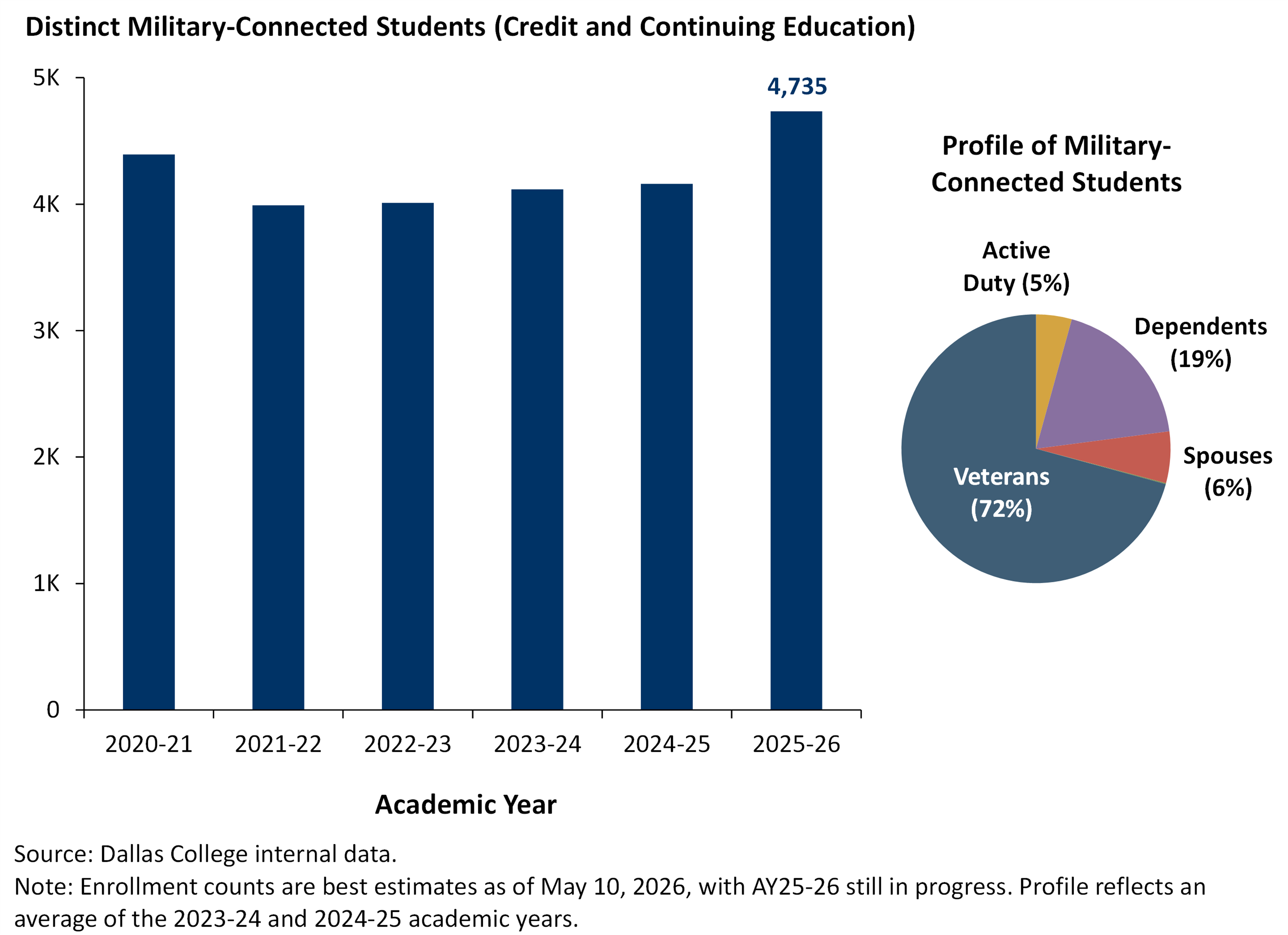
Overall, total military-connected headcounts have been roughly stable at 4,000-5,000 per year since AY20-21 (Figure 2), with current estimates at 4,735 students for AY25-26. While we see a recent uptick, we caution that year-to-year changes may reflect improved data integration and identification methods rather than underlying population shifts. Over the most recent years (AY23-24 and AY24-25), veterans have represented around 72% of the overall military-connected population, or roughly 3,000 students per year, including both credit and Continuing Education enrollment. Besides veterans, around 19% of Dallas College’s military-connected student population were dependents of veterans, 6% were spouses, and 5% were active duty. As of early May 2026, around 2,000 military-connected students had applied for military or veteran benefits at Dallas College, with 1,700 of these applications approved, and the others still in process or not eligible. These values suggest a number of veteran students may be identified through self-reported survey data but not fully applying for or utilizing potential benefits.
Programs of Study and Completion
From the College’s internal data, military-connected students were awarded a variety of types of credentials from academic year 2022-2023 to 2024-2025 (Table 5). While academic associate degrees remain the most commonly awarded credentials for military-connected students (26% in total), these students also have greater presence in skilled trade and public service roles like emergency and para- medicine (6.8%), information security (2.0%), real estate (1.9%), and criminal justice (1%). Overall, military-connected students pursue a wide range of programs, with very few credentials being awarded to more than 1-2% of students. The population of non-military-connected students, while still quite diverse in terms of credentials conferred, is more highly concentrated in academic associate degrees designed for transfer (32.4% in total) and skills awards intended to support professional readiness (e.g., for health professions at 2.6%).
Table 5. Top Ten Credentials Completed, Military-Connected and All Other Students
|
Rank |
Military-Connected Students |
All Other Students |
||
|
1 |
Associate of Science |
15.8% |
Associate of Science |
23.5% |
|
2 |
Associate of Arts |
10.2% |
Associate of Arts |
8.9% |
|
3 |
EMS – Paramedic Certificate |
5.5% |
AAT – Early Childhood to Grade 6 |
1.5% |
|
4 |
CIT – Information Security OSA |
2.0% |
Health Professions Readiness I SA |
1.4% |
|
5 |
Real Estate Certificate |
1.9% |
EMS – Paramedic Certificate |
1.2% |
|
6 |
EMS – EMT Certificate |
1.3% |
Health Professions Readiness II SA |
1.2% |
|
7 |
AA w/ FOS in Business Admin/Mgmt |
1.3% |
AA w/ FOS in Business Admin/Mgmt |
1.1% |
|
8 |
AAT – Early Childhood to Grade 6 |
1.2% |
Accounting Clerk |
1.1% |
|
9 |
Criminal Justice Certificate |
1.0% |
Business Admin – HR Assistant |
1.1% |
|
10 |
Accounting Clerk |
0.9% |
CIT – Information Security OSA |
1.0% |
Source: Dallas College internal data.
Note: Percentages of top credentials out of all credentials awarded are calculated from academic years 2022-2023, 2023-2024, and 2024-2025 pooled together.
Career Outcomes
Administrative data on the career outcomes of Dallas College veteran students are limited, but survey data offer preliminary insights into their outcomes after graduation. Responses from 79 student veteran graduates in AY 2024-25 on the First Destination Survey show that within one to six months of graduation, 30% were employed, 27% were transferring or pursuing further education, and 28% were both working and enrolled in college. Only 15% of veteran graduates were still determining their next steps within the first few months of leaving Dallas College. A large majority of graduates felt confident about their preparation: 72% strongly agreed they were ready for their next steps, and 76% strongly agreed that their Dallas College education was worth the investment of time and money. Among those who were employed, nearly 83% of veteran graduates worked full-time (30 or more hours per week), but their income levels varied. Interestingly, the largest proportion of graduates (over 18%) had an annual income of $100,000 or more, and almost 16% of graduates fell into each of the $50,000 to $59,000 and $70,000 to $79,000 income ranges. This suggests that many veterans are securing stable, middle-income employment soon after graduation, which is likely supported in part by federal and state veteran benefits. Around 13% of graduates reported annual earnings between $20,000 and $29,000, while smaller proportions fell into the $40,000 to $49,000 (11%) and $30,000 to $39,000 (8%) income brackets.
Further details on the employment sectors of veteran graduates show that the largest proportions are working in Education Services and Other Services (nonidentified), each employing about 18% of graduates. Veteran representation is also strong in the Healthcare and Social Assistance sector (16%); however, representation is lower in sectors such as Finance and Insurance (11%) and Public Administration and Professional, Scientific, and Technical Services (both approximately 8%). A closer look at occupation types within these sectors shows that graduates most frequently enter Management roles (over 18%), consistent with County-level findings, positions in Business and Financial Operations (16%), and roles in Educational Instruction and Library settings (also 16%). Over 71% of graduates report that their occupations are directly or mostly related to the programs of study they completed at Dallas College, and almost 11% say their work is somewhat related.
In response to how veteran graduates expect their employment situation to change after completing their Dallas College education, nearly half indicate upward mobility, with 47% expecting a promotion or raise and 44% anticipating a change in career or field. At the same time, many are pursuing new or independent opportunities. Around 28% identify as entrepreneurs or self-employed, and 25% plan to work for a new employer, which suggests that their education is allowing them to explore different career paths. Some respondents appear to be in more transitional stages. Approximately 22% participate in internships or fellowships, and 16% report working multiple jobs, which may indicate ongoing education. Smaller proportions engage in temporary/contract work (9%) or freelance/gig work (6%). Overall, the findings indicate that veteran graduates are experiencing positive career momentum, either progressing within their current roles or transitioning into new career paths, and relatively few are in temporary or less stable forms of employment.
Unique Opportunities
Insights from Qualitative Research
A pulse study conducted by the Student Success Research (SSR) team in 2023-2024 indicates that veterans and military-connected students face complex and often confusing enrollment and onboarding processes. This is largely due to changing policies and the prevalence of outdated or inaccurate information regarding their educational and financial benefits, which can delay their progress towards credential completion. Many rely heavily on these benefits for income, which may lead them to change their academic plans to maintain financial stability instead of pursuing their intended goals. Also, many veteran students experience an inconsistent sense of belonging because awareness of campus resources and events remains limited, especially for online and non-traditional students with scheduling constraints. They also struggle to build peer connections often in part due to age differences and discomfort in mixed classroom environments, particularly with dual credit students. Military-connected staff act as essential advocates by guiding students through institutional processes and helping them navigate benefits. At the same time, students encounter challenges transitioning from military to civilian and academic life and often seek clearer direction and personalized support. Improving communication, making resources more visible, simplifying their path to receiving credit for prior learning, and creating more opportunities for veteran students to connect can enhance their engagement, persistence, and overall success.
Financial Policies to Support Postsecondary Access and Completion
Many federal and state financial policies (some designed specifically for veterans and others available to all students) make postsecondary education more attainable and affordable for veterans. At the federal level, programs administered by the U.S. Department of Veterans Affairs (VA), including the Post-9/11 GI Bill, the Montgomery GI Bill, and the Veterans Readiness and Employment program (for veterans with service-connected disabilities), cover tuition, provide monthly housing allowances, and offer stipends for books and supplies among other benefits, which greatly reduces the overall cost of attendance (U.S. Department of Veterans Affairs, 2025a; 2025b; 2025c). At the state level, the Hazlewood Act in Texas provides up to 150 credit hours of tuition exemption at public institutions and serves as a complement or alternative to the federal benefits (Texas Veterans Commission, 2026b). When combined with other need-based aid, such as the Pell Grant and the Texas Educational Opportunity Grant as well as institution-based aid (e.g., scholarships), veterans can cover additional, non-education-related expenses. Recent federal policy updates will further expand educational opportunities for veterans, specifically with the introduction of Workforce Pell, which extends funding for non-credit/CE short-term training programs (Texas Higher Education Coordinating Board, 2025). Because program of study data suggests that veterans generally prefer technical pathways, the increased flexibility of workforce-focused Pell will allow them access funding for both academic degrees and credentials aligned with high-demand careers. Beyond financial aid, programs coordinated through the Texas Workforce Commission (TWC) can help fund workforce training, certifications, and career transitions, to ensure veterans can quickly enter or progress in the labor market (Texas Workforce Commission, 2026). By using these resources together, veterans can reduce out-of-pocket costs and keep their educational options flexible.
Strategies to (Re)-Enroll Veterans at Dallas College
To increase veteran enrollment and re-enrollment, the College should build a proactive outreach strategy that makes federal, state, and college resources easier to find before students apply and throughout their first year. Messaging should clearly explain how veterans can combine VA, FAFSA, and other benefits to reduce costs and purse both credit and short-term workforce pathways. Dallas College can also improve awareness of its Military-Connected offices, advising, credit for military training, benefits certification, emergency aid, housing support, mental health referrals, career services, and transfer resources. The SSR research indicates that confusing benefits information, unclear enrollment processes, and limited awareness of veteran events on campuses can delay progress and decrease sense of belonging. Outreach through partnerships with veteran service organizations and VA hospitals should target veterans in Dallas County and nearby underserved communities. Re-enrollment efforts should focus on tailored advising that includes review of veterans’ remaining credits, benefits eligibility, prior military learning, course scheduling options, and high-demand programs that match their career goals. Dallas College can also develop and expand veteran orientations, peer mentoring, learning communities, resource fairs, and social events—offered both in-person and online. These strategies should recognize that many veterans are also adult learners who balance work, family, academics, and the transition from military into civilian life.
Conclusion
This brief shows that veterans in the Dallas–Fort Worth region represent an important opportunity for Dallas College, particularly given the considerable veteran population in Dallas County and the availability of federal, state, and institutional supports. While many veterans enroll in credit-bearing pathways and pursue programs linked to workforce advancement, they continue to face barriers related to complex onboarding and benefits processes, and limited awareness of available resources. Simplifying communication, improving coordination of veteran services, and focusing on early outreach efforts can help Dallas College increase veteran enrollment and re-enrollment and program completion.
Dallas College. (2026a). Education and workforce committee spring 2026 enrollment update [Internal PowerPoint slides]. Dallas College.
Dallas College. (2026b). Military connected services. https://www.dallascollege.edu/resources/veterans/
Dallas County. (n.d.). Veterans benefits: Education. https://www.dallascounty.org/departments/veteran-services/education.php
Ruggles, S., Flood, S., Sobek, M., Backman, D., Cooper, G., Rivera Drew, J. A., Richards, S., Rodgers, R., Schroeder, J., & Williams, K. C. W. (2025). IPUMS USA: Version 16.0 [Dataset]. IPUMS. https://doi.org/10.18128/D010.V16.0
Texas Higher Education Coordinating Board. (2025). Workforce Pell grant (WPG) program. https://www.highered.texas.gov/grants/workforce-pell-grant-wpg-program/
Texas Veterans Commission. (2026a). About the G.I. Bill. https://tvc.texas.gov/education/gi-bill/
Texas Veterans Commission. (2026b). Hazlewood Act. https://tvc.texas.gov/education/hazlewood/
Texas Workforce Commission. (2026). Just for veterans. https://www.twc.texas.gov/services/veterans
Texas Workforce Investment Council. (2025). Veterans in Texas: A demographic study. https://gov.texas.gov/uploads/files/organization/twic/Veterans-2025-Accessible.pdf
U.S. Census Bureau. (2024). Veteran status (Table S2101, 2024 American Community Survey 5-year estimates). https://data.census.gov/table/ACSST5Y2024.S2101?q=veteran+status+(5-year)
U.S. Department of Veterans Affairs. (2025a). Montgomery GI bill active duty (MGIB-AD). https://www.va.gov/education/about-gi-bill-benefits/montgomery-active-duty/
U.S. Department of Veterans Affairs. (2025b). Post-9/11 GI bill (chapter 33). https://www.va.gov/education/about-gi-bill-benefits/post-9-11/
U.S. Department of Veterans Affairs. (2025c). Veteran readiness and employment (chapter 31). https://www.va.gov/careers-employment/vocational-rehabilitation/